How Long Until 3 PM Today?
If you want to know how long until 3 PM, the answer is simple: subtract your current time from 3:00 PM, and the result is the hours and minutes still left. The live timer below does that math for you automatically, showing the exact remaining time down to the second, adjusted to your device’s timezone.
Whether you are watching the clock at work, timing a school pickup, or just curious how much afternoon you have left, 3 PM is one of the most-tracked times of the day. This guide explains why, shows you exactly how to calculate the remaining time by hand, and gives you reference tables so you never have to do the arithmetic yourself.
How long until 3 PM? Why it matters
Few times of day get looked up as often as 3 PM. It sits right in the middle of the afternoon, a point where the morning feels far behind and the evening still feels like a promise rather than a plan. For millions of office workers, 3 PM is the classic afternoon slump hour — that stretch after lunch when energy dips, focus wobbles, and people start doing mental math about how much of the workday is behind them. Searching “how long until 3 PM” at 1:30 is really a way of asking “how much longer do I have to power through?”
Parents know 3 PM for a different reason: it is school dismissal time for millions of kids. For families with children in elementary or middle school, the 3 PM pickup is the pivot around which the whole afternoon schedule rotates — snacks packed, car keys ready, traffic timed so you are in the pickup line before the bell. A parent checking the countdown at 2:15 is calculating whether there is time to fold one more load of laundry or run one more errand before leaving.
The rest of the audience is just as broad. Shift workers in retail, healthcare, and logistics hit shift changes around 3 PM and need to know when the handoff happens. Students check it between classes. Remote workers scattered across time zones use 3 PM in someone’s local time as a default meeting slot, because it is late enough to be serious but early enough not to wreck the end of the day. Doctors’ offices, salons, repair technicians, and delivery drivers all love the 3 PM appointment window, which means anyone with a booking wants to know exactly how long they have to get ready.
Psychologically, 3 PM is also a “halfway through the afternoon” marker. It divides the stretch between lunch and dinner into something measurable. There is a coffee-break culture built around it — the mid-afternoon espresso, the vending-machine run, the short walk around the block — and all of it is timed against the 3 o’clock anchor.
There is also a practical, almost invisible reason 3 PM shows up so often in search boxes: it is a default. Scheduling software, booking systems, and calendar apps frequently suggest 3 PM as a mid-afternoon slot, so people end up with 3 PM appointments they did not consciously choose and then check how long they have. Television lineups, radio shows, and school activity schedules cluster around it too, because it catches both the after-lunch crowd and the soon-to-be-home crowd. Even the famous “3 PM slump” has research behind it — core body temperature dips slightly in mid-afternoon, which is why the hour feels heavier than the clock suggests. In short, 3 PM is not just a number on the clock. It is the hour when the day’s second half officially begins.
Understanding how long until 3 PM works
The live countdown timer at the top of this page shows you the exact time remaining until 3 PM today: hours, minutes, and seconds, ticking down every second. It runs on your device’s own timezone, so whether you are on the East Coast, the West Coast, or anywhere else, the timer is counting toward 3 PM in your local time — no conversion needed on your part.
Reading the countdown is straightforward. If it shows 2:14:33, that means 2 hours, 14 minutes, and 33 seconds remain until 3 PM. The seconds tick down continuously, so the number you see is always accurate to the moment. This is the fastest way to answer “how long until 3 PM” because you never have to glance at a clock and do subtraction in your head.
One detail worth understanding: 3 PM is 15:00 in 24-hour time. Most digital systems, scheduling tools, and the countdown timer itself treat it as 15:00, so if you ever need to set an alarm, book a calendar slot, or enter the time into an app, “15:00” is what you are looking for. The 24-hour format removes the AM/PM ambiguity entirely, which is why hospitals, airlines, and the military rely on it.
Finally, note the difference between “3 PM today” and tomorrow’s 3 PM. The timer above counts down to today’s 3 PM as long as it is still ahead of you. The moment the clock passes 3:00 PM, today’s countdown is over — the next 3 PM in your future is tomorrow’s. The timer handles that rollover automatically, switching to count down to 3 PM the following day. There is a full explanation of that behavior, with its own reference table, later in this article.
One more thing to keep in mind: the timer is only as accurate as your device’s clock. If your phone or computer’s time is off by a few minutes — which happens more often than people realize on devices with manual time settings — the countdown will be off by the same amount. If the timer ever disagrees with a clock you trust, check that your device is set to automatic date and time before assuming the timer is wrong. With automatic time enabled, the countdown matches your device’s clock exactly, down to the second.
3 PM countdown reference table
If you would rather glance at a table than do math, here is the exact time left until 3 PM for every half hour from early morning through the afternoon. Find the row closest to the current time to see how long you have to wait.
| Current time | Time left until 3 PM |
|---|---|
| 6:00 AM | 9 hours |
| 6:30 AM | 8 hours 30 minutes |
| 7:00 AM | 8 hours |
| 7:30 AM | 7 hours 30 minutes |
| 8:00 AM | 7 hours |
| 8:30 AM | 6 hours 30 minutes |
| 9:00 AM | 6 hours |
| 9:30 AM | 5 hours 30 minutes |
| 10:00 AM | 5 hours |
| 10:30 AM | 4 hours 30 minutes |
| 11:00 AM | 4 hours |
| 11:30 AM | 3 hours 30 minutes |
| 12:00 PM | 3 hours |
| 12:30 PM | 2 hours 30 minutes |
| 1:00 PM | 2 hours |
| 1:30 PM | 1 hour 30 minutes |
| 2:00 PM | 1 hour |
| 2:30 PM | 30 minutes |
| 3:00 PM | 0 — it’s 3 PM now |
Notice the pattern: the remaining time drops by exactly 30 minutes for each half-hour row, which makes the table easy to sanity-check at a glance. If your exact time falls between two rows — say it is 2:15 PM — the answer is halfway between the neighboring rows, so about 45 minutes. For anything between rows, the live timer at the top of the page gives you the precise figure including seconds.
What if it is already past 3 PM?
If it is already past 3:00 PM, then today’s 3 PM has come and gone — and the next 3 PM you can count down to is tomorrow’s. This is the rollover behavior built into the countdown timer: the instant the current time passes 3:00 PM, the timer stops counting toward “today” and starts counting toward 3 PM the following day.
That means if you check the timer at 6 PM, you will see a large number — not a glitch, just the full wait until the next 3 PM arrives. The same logic applies to any time after the 3 PM mark: add up the hours left in today plus the hours into tomorrow. The table below does that work for you, listing the exact wait from each hour of the evening until tomorrow’s 3 PM.
| Current time (evening) | Time until tomorrow’s 3 PM |
|---|---|
| 4:00 PM | 23 hours |
| 5:00 PM | 22 hours |
| 6:00 PM | 21 hours |
| 7:00 PM | 20 hours |
| 8:00 PM | 19 hours |
| 9:00 PM | 18 hours |
| 10:00 PM | 17 hours |
| 11:00 PM | 16 hours |
Each row is exactly one hour less than the previous one, which makes sense: every hour you wait brings tomorrow’s 3 PM one hour closer. If you are between rows — for example, 7:30 PM — add the leftover minutes to the nearest row, so about 19 hours 30 minutes. And if you are up very late or very early, the math continues the same way: at midnight it is 15 hours, at 1 AM it is 14 hours, and so on down to the morning table above. The timer handles all of this automatically, but it is useful to understand the logic so the number it shows after hours always makes sense to you.
The math behind the countdown
Doing this by hand takes one formula. Because 3 PM is 15:00 in 24-hour time, and 15 hours times 60 minutes equals 900 minutes, 3 PM sits exactly 900 minutes after midnight. So the time remaining until 3 PM is simply:
Minutes until 3 PM = 900 − (minutes after midnight right now)
To get “minutes after midnight” for your current time, multiply the 24-hour hour by 60 and add the minutes. For example, 1:20 PM is hour 13 in 24-hour time, so 13 × 60 + 20 = 800 minutes after midnight. Then 900 − 800 = 100 minutes left, which is 1 hour and 40 minutes. If you want seconds instead, multiply the minutes by 60.
Here are three fully worked examples so you can see every step.
Example A: It is 1:20 PM. First convert to 24-hour time: 1:20 PM becomes 13:20. Multiply the hour: 13 × 60 = 780 minutes. Add the minutes: 780 + 20 = 800 minutes after midnight. Subtract from 900: 900 − 800 = 100 minutes remaining. Convert to hours and minutes: 100 minutes = 1 hour and 40 minutes. Convert to seconds: 100 × 60 = 6,000 seconds.
Example B: It is 2:47 PM. Convert to 24-hour time: 2:47 PM becomes 14:47. Multiply the hour: 14 × 60 = 840 minutes. Add the minutes: 840 + 47 = 887 minutes after midnight. Subtract from 900: 900 − 887 = 13 minutes remaining. Convert to seconds: 13 × 60 = 780 seconds. This one is close — just 13 minutes to go.
Example C: It is 11:05 AM. Convert to 24-hour time: 11:05 AM stays 11:05. Multiply the hour: 11 × 60 = 660 minutes. Add the minutes: 660 + 5 = 665 minutes after midnight. Subtract from 900: 900 − 665 = 235 minutes remaining. Convert to hours and minutes: 235 minutes = 3 hours and 55 minutes (180 + 55). Convert to seconds: 235 × 60 = 14,100 seconds.
If the current time is past 3 PM, the same formula works with a tweak: instead of subtracting from 900, compute (1440 − minutes after midnight) + 900, where 1440 is the total minutes in a day. At 6 PM (1080 minutes after midnight), that gives (1440 − 1080) + 900 = 360 + 900 = 1260 minutes, which is exactly 21 hours — matching the evening table above.
Nearby times worth watching
When you are tracking 3 PM, the hours and half-hours around it matter too — each one plays a role in planning your afternoon.
2:00 PM — the last full hour. When the clock hits 2, exactly one hour remains until 3. This is your final meaningful work window: long enough for a full focus block, a short meeting, or a solid chunk of errands. If you have been putting off something “until later,” 2 PM is the moment later becomes now.
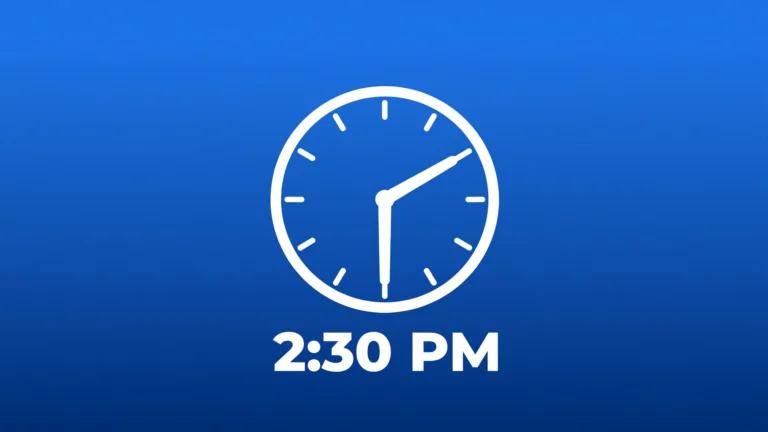
2:30 PM — the final stretch. Half an hour out, 3 PM stops being an abstract future and becomes imminent. This is when parents start gathering keys and bags for school pickup, workers start wrapping up tasks so they can leave on time, and appointment-holders start getting ready to head out. If the live timer shows under 30 minutes, you are in countdown mode.
3:30 PM — just after the mark. Missed 3 PM? Thirty minutes past it, you are still close enough that most schedules have some slack. School pickup lines are still moving, most 3 PM appointments will still see you if you are running a little behind, and shift handoffs are usually still in progress. It is the grace-period zone of the afternoon.
4:00 PM — late afternoon. One hour past 3, the afternoon has a noticeably different feel. The post-3 PM dip has usually lifted, the school-run traffic has cleared, and the countdown toward the end of the day takes over from the countdown toward 3 PM. If 3 was your checkpoint, 4 is when you start measuring what the checkpoint accomplished.
Making the most of the time left until 3 PM
Knowing the countdown is only half the value — using the remaining time well is the other half. Here is how to turn “hours until 3 PM” into a genuinely productive plan.
Beat the afternoon slump with 25-minute blocks. The classic post-lunch dip hits hardest between 1 and 3 PM, and willpower alone rarely beats it. Instead, run focused 25-minute work sprints with 5-minute breaks between them. If the timer shows 2 hours left, that is four full sprints — enough to clear an inbox, draft a report, or finish a task you have been avoiding. The countdown becomes your ally: each sprint visibly eats into the remaining time.
Prep for school pickup without the last-minute scramble. If 3 PM means the school run, work backward from it. Thirty minutes before, start gathering bags, snacks, and anything the kids will need. Twenty minutes before, check traffic. Ten minutes before, be out the door. Parents who time this routine against the countdown stop doing the frantic 2:55 PM dash and start arriving calmly at 2:50.
Time a workout to end by 3. A 45-minute workout fits neatly into the early-afternoon window. Starting at 2:00 PM puts you back, showered, and settled by 3 — with the added bonus that exercise is the single most effective cure for the afternoon slump. Even a 20-minute walk at 2:30 resets your energy and gets you back before the hour turns.
Schedule calls inside the remaining window. If you have calls or errands to fit before 3, the countdown tells you exactly how much runway you have. A 90-minute gap means one long call or two short ones; a 45-minute gap means one quick call, booked now. People who check the timer before committing to a “quick call” avoid the classic mistake of starting something at 2:40 that bleeds past their 3 PM commitment.
Use 3 PM as a daily checkpoint. The most powerful use of the countdown is structural: treat 3 PM as the moment you review the day. Morning goals met? Afternoon priorities queued for the final stretch? A two-minute review at the 3 PM mark — while the timer reads zero — turns an ordinary hour into a daily ritual that keeps the whole week on track.
Share the countdown with the household. A 3 PM deadline gets easier when everyone can see it. Parents use the timer as a visual anchor for kids: “screen time ends when the countdown hits zero,” or “we leave for pickup when there are 20 minutes left.” Because the timer ticks in real time, children who cannot yet read a clock can still watch the numbers shrink, which ends the constant “how much longer?” questions. Put the page up on a shared tablet or family computer and the whole afternoon runs on the same clock.
Frequently asked questions
How many minutes is it from 1 PM to 3 PM?
It is exactly 120 minutes, which is 2 hours. From 1:00 PM to 3:00 PM you cross one full hour (to 2:00 PM) and a second full hour (to 3:00 PM). If you are starting from 1:30 PM instead, the answer is 90 minutes, or 1 hour 30 minutes.
What is 3 PM in 24-hour/military time?
3 PM is 15:00 in 24-hour and military time. The conversion rule is simple: for any PM hour except 12 PM, add 12 to the hour. So 3 + 12 = 15, written as 15:00 (military format often drops the colon: 1500).
How long is 7 AM to 3 PM?
From 7:00 AM to 3:00 PM is exactly 8 hours. That is 7 AM to noon (5 hours) plus noon to 3 PM (3 hours), totaling 8 hours — the length of a standard full-time workday shift, which is why 7-to-3 is such a common schedule.
Is 3 PM afternoon or evening?
3 PM is firmly afternoon. The afternoon runs from 12:00 PM (noon) to about 5:00 or 6:00 PM, depending on convention. Evening begins around 5–6 PM as daylight fades. Nobody calls 3 PM evening — it is mid-afternoon, the exact middle of the 12 PM to 6 PM stretch.
How many seconds until 3 PM from 2:30 PM?
From 2:30 PM to 3:00 PM is 30 minutes, and 30 × 60 = 1,800 seconds. So if you check the live timer at exactly 2:30 PM, it will read 0:30:00 — thirty minutes, zero seconds into the minute — and the seconds figure of 1,800 counts down from there.
What is half past 2 in relation to 3 PM?
Half past 2 is 2:30 PM, which is exactly 30 minutes before 3 PM. “Half past the hour” always means 30 minutes after that hour, so half past 2 leaves you precisely one half-hour from the 3 o’clock mark.
Why is 3 PM called mid-afternoon?
Because it sits at the midpoint of the afternoon. If you define the afternoon as noon (12 PM) to 6 PM, the exact middle is 3 PM. That central position is why it feels like a natural divider — the morning half of the afternoon is behind you, the evening half is ahead.
Does the timer work during daylight saving changes?
Yes. The countdown timer reads your device’s current local time, which already reflects daylight saving adjustments made by your operating system. On the spring-forward and fall-back days, the timer counts to 3 PM local time just like any other day — the only difference is that the total span of the day itself is an hour shorter or longer, which the timer handles because it always measures from “now.”
How long until 3 PM if it’s 2:59 PM?
Just 1 minute — 60 seconds. At 2:59 PM the live timer will show 0:01:00 (or less, depending on the seconds). This is the shortest meaningful “how long until 3 PM” answer: anything closer than a minute and you are essentially already there.
What is 3 PM in UTC?
3 PM is not a fixed UTC time — it depends on your timezone’s offset. 3 PM Eastern is 19:00 or 20:00 UTC depending on daylight saving; 3 PM Pacific is 22:00 or 23:00 UTC. If someone says “3 PM UTC,” they mean 15:00 UTC, which is 3 PM only for people in the UTC timezone itself (like London in winter).
Can I count down to 3 PM in a different timezone?
The timer on this page always counts to 3 PM in your device’s timezone. To count down to 3 PM in another timezone, temporarily change your device’s timezone setting, or do the conversion manually: find the offset between your timezone and the target one, and adjust the countdown. For example, 3 PM Eastern is noon Pacific, so a person in Los Angeles counting to New York’s 3 PM is really counting to their own 12 PM.
Why do schools dismiss around 3 PM?
The 3 PM dismissal traces back to the traditional school day designed around a 9-to-3 or 8:30-to-3 schedule — roughly six hours of instruction with a lunch break, fitting the afternoon bus routes before rush hour and getting kids home in daylight for most of the year. While start times have shifted in many districts, the 3 PM end-of-day anchor has stuck because bus fleets, after-school programs, and working parents’ schedules are all built around it.
Related countdowns
For an independent reference clock, see the world clock on timeanddate.com.